
One of the most important cases which have political implications is the Ayodhya land dispute case.
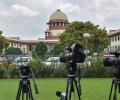
The Collegium's recommendations, if accepted by the Centre, will raise the total number of judges in the apex court to 33 against the sanctioned strength of 34 including the CJI.
The order will be passed by a five-judge Constitution bench of Chief Justice Ranjan Gogoi, Justices NV Ramana, DY Chandrachud, Deepak Gupta and Sanjiv Khanna on a petition filed by a Supreme Court Secretary-General challenging the January 2010 judgment of the Delhi high court.
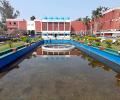
Merely because an educational institution is regulated by a statute does not take away from it the character of a minority institution, the Supreme Court observed on Tuesday as it commenced hearing the vexed question of minority status of Aligarh Muslim University (AMU).
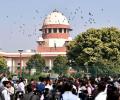
In a landmark judgment that delivered a big blow to the government, the Supreme Court on Thursday annulled the electoral bonds scheme, saying it violates the constitutional right to freedom of speech and expression as well as the right to information.

How does it matter for people whether the Aligarh Muslim University is a minority institution or not when it has continued to be an institute of national importance without the minority tag, the Supreme Court said on Thursday as it underlined that the intent of Article 30 of the Constitution is not to "ghettoise the minority".

A five-judge Constitution bench headed by Chief Justice D Y Chandrachud, which was hearing an application filed by the Election Commission (EC) seeking a modification of the operative portion of its March 11 order in the electoral bonds case, directed its registrar (judicial) to ensure that the data filed earlier by the poll panel before it in a sealed cover be scanned and digitised.

The State Bank of India told the Supreme Court on Thursday it has provided all details of the electoral bonds in its possession to the Election Commission.
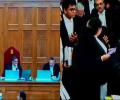
Who can recommend the revocation of Article 370 in Jammu and Kashmir when no constituent assembly exists there? The Supreme Court on Wednesday put this question to the petitioners who have challenged the abrogation of the constitutional provision that bestowed special status on the erstwhile state.

The five-judge constitution bench headed by Chief Justice DY Chandrachud, which heard their contentions at length, told them they will have to justify the procedure adopted for abrogation as the court cannot postulate a situation "where the ends justify the means".

The Supreme Court collegium headed by Chief Justice of India DY Chandrachud on Tuesday recommended to the Centre the names of Andhra Pradesh high court chief justice Prashant Kumar Mishra and senior advocate KV Viswanathan as judges of the apex court.
An institution of national importance must reflect the "national structure", the Centre told the Supreme Court on Tuesday while pointing out that around 70 to 80 per cent students studying at Aligarh Muslim University (AMU) are Muslims even without reservation.
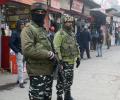
The Supreme Court on Monday ruled the former state of Jammu and Kashmir did not have any 'internal sovereignty' that was distinguishable from the powers and privileges enjoyed by other states in the country.
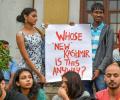
The Supreme Court said on Thursday the surrender of Jammu and Kashmir's sovereignty to India was "absolutely complete" with the accession of the former princely state in October 1947, and it was "really difficult" to say that Article 370 of the Constitution, which accorded special status to the erstwhile state, was permanent in nature.
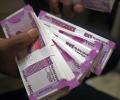
The Centre told the Supreme Court on Wednesday that almost every country, including India, was grappling with the problem of use of black money in elections and the electoral bonds scheme was a "conscious attempt" to eradicate the menace of "unclean money" in the poll process.
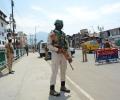
The central government's response was conveyed to the court by Solicitor General Tushar Mehta, after a five-judge constitution bench headed by Chief Justice DY Chandrachud, hearing the pleas challenging the abrogation of Article 370, asked it to set a specific time frame for restoration of electoral democracy in the erstwhile state.

The Supreme Court on Monday asked National Conference leader Mohammed Akbar Lone to file an affidavit swearing allegiance to the Constitution of India and accepting the country's sovereignty, after the 'Pakistan zindabad' slogan that he allegedly raised in the Jammu and Kashmir assembly in 2018 kicked up a massive row.
Holding that the electoral bonds scheme was not fool-proof, the Supreme Court said on Thursday that information about funds received by a political party is essential for voters to exercise their freedom to vote effectively.
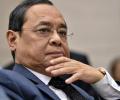
A bench comprising CJI and Justice Sanjiv Khanna was hearing a PIL filed by NGO Common Cause challenging the appointment of Rao as interim CBI director.
National Conference leader Mohammed Akbar Lone on Tuesday filed an affidavit in the Supreme Court reiterating his oath as Lok Sabha MP, saying he will preserve and uphold the Constitution and protect the country's territorial integrity, an undertaking that irked the Centre which claimed it added "insult to injury to the nation".

The "opaque" electoral bonds scheme for funding political parties will "destroy democracy" as it promotes corruption and does not allow a level playing field between the ruling and opposition parties, the petitioners challenging the validity of the scheme told the Supreme Court, which on Tuesday observed election funding was a "complicated issue".

The Supreme Court on Tuesday termed as "unacceptable" the submission that Article 370 of the Constitution ceased to operate once the term of the constituent assembly of Jammu and Kashmir ended in 1957 after drafting the state's constitution.

Grappling with the intractable issue of Aligarh Muslim University's minority status, the Supreme Court said on Thursday the 1981 amendment to the AMU Act, which effectively accorded it a minority status, only did a "half-hearted job" and not restore to the institution the position it had prior to 1951.
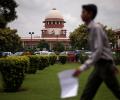
The Supreme Court, examining whether states can sub-classify Scheduled Castes and Scheduled Tribes for grant of quota inside quota, on Wednesday said all SCs and STs may not be homogeneous in terms of their sociological, economic, education and social status.
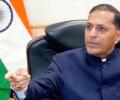
The bench refused to entertain the plea filed by NGO Association for Democratic Reforms and dismissed it.
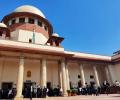
Tewari, a Congress leader and Lok Sabha MP, was appearing for former Arunachal Pradesh MLA Padi Richo, who has filed an intervention application in a batch of petitions challenging abrogation of Article 370.
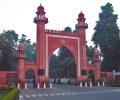
The mere fact that some part of administration of an educational institution is also looked after by non-minority officials does not "dilute" its minority character, the Supreme Court observed on Wednesday while hearing the hugely disputed minority status of Aligarh Muslim University (AMU).

The Supreme Court on Wednesday asked whether Parliament could have enacted the Jammu and Kashmir Reorganisation Act, which divided the erstwhile state into two Union territories, during the subsistence of President's rule in 2018-2019.

We must heed what the CJI has said. Challenging every judgment of the central government is inviting chaos, asserts Shreekant Sambrani.
The Supreme Court collegium on Tuesday recommended to the Centre the names of Allahabad high court Chief Justice Rajesh Bindal and Gujarat high court Chief Justice Aravind Kumar for elevation as apex court judges.
Is there no mechanism to abrogate Article 370 even when the people of Jammu and Kashmir want it, the Supreme Court asked on Thursday and wondered if the now repealed provision can't be touched, will it not amount to creating a "new category" beyond the basic structure of the Constitution.

Elections in Jammu and Kashmir can be held "anytime from now" as the work on updation of voters list is almost over, the Centre told the Supreme Court on Thursday but remained non-committal about setting a time-frame for restoration of statehood to the Union territory (UT).
There is no question of a Brexit-like referendum on the abrogation of Article 370 in Jammu and Kashmir, the Supreme Court said on Tuesday, as it grappled with the question as to whether its repeal was constitutionally legal.

The SC said Rao has prima facie committed contempt of court by transferring Sharma without taking court's consent.
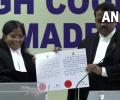
a special bench comprising Justices Sanjiv Khanna and B R Gavai said they were 'not entertaining the writ petition' that sought to restrain Gowri from taking oath 'in view of the grave threat to the independence of the judiciary'.

Vice President Dhankar's and Law Minister Rijuju's recent interventions have the danger of destabilising the Constitutional equilibrium, cautions N Sathiya Moorthy.

A bench headed by Chief Justice S A Bobde took note of the submissions by a battery of senior lawyers including A M Singhvi and C A Sundaram and said it will list the fresh pleas "sometime in next week" before the same bench which had heard the earlier petition in the high-stake matter.
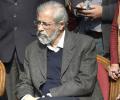
A row erupted after the Chief Justice of India Ranjan Gogoi-headed five-judge Collegium in a fresh resolution on January 10 recommended the elevation of Justice Dinesh Maheshwari and Justice Sanjiv Khanna to the Supreme Court bypassing the seniority of several judges.
Kumar's lawyer mentioned the matter for urgent listing before a vacation bench comprising Justices Indira Banerjee and Sanjiv Khanna.
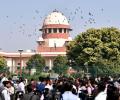
The bench said it was necessary that question of 'judicial independence is accounted for in the balancing exercise' with RTI.
 © 2026 Rediff.com - Advertise with us - Disclaimer - Privacy Policy - Sitemap - Feedback - About us - Terms of use - Grievances